Quick answer
Extend the life of a metal band saw by choosing the right blade for the material, maintaining proper blade tension and alignment, using the right cutting speed and feed pressure, cleaning chips regularly, and inspecting the blade and machine components on a routine schedule. Reactive repairs after a blade fails cost far more than the few minutes routine maintenance takes.
Summary
A metal band saw is a power tool used to cut everything from plastic and wood to metal and other materials. They are reliable tools, but they also have a fixed shelf life. However, with proper care, you can extend their shelf life. Learn why regular maintenance matters and how it keeps your metal cutting band saw in good condition.
- Choose the right blade for the material, thickness, and shape you’re cutting.
- Maintain proper blade tension and alignment according to the machine manufacturer’s instructions.
- Use appropriate cutting speeds, feed pressure, and coolant or lubricant.
- Clean chips and debris regularly to prevent premature wear.
- Inspect blades, guides, wheels, and moving components for signs of damage.
- Do not use a metal cutting band saw beyond its rated capacity.
- Proper maintenance improves blade life, cut quality, equipment reliability, and workshop efficiency.
A metal band saw makes repeatable, controlled cuts across a variety of materials. In the metal industry, metal band saws play a crucial role, as metals are hard to cut and expert cutting produces polished finishes when used correctly.
The blade is the backbone of a metal saw and should be maintained properly to avoid crooked cuts, excessive vibration, premature blade breakage, overheating, and poor surface quality.
This blog shares expert tips to help professionals keep metal cutting saws in good shape for longer.
Metal Band Saw Maintenance Tips
Check out these tips from experts that will help you maintain your cutting tools:
Choose the Correct Blade for the Material
Blade selection is the first step in preventing premature wear. A blade designed for steel might not be the best choice for aluminum or brass. Tooth pitch, tooth geometry, blade thickness, and material compatibility all influence cutting performance and service life.
Before installing a blade, check the manufacturer’s recommendations for the material and machine.
The same principle applies to circular saws, metal cold saws, and band saws. Use them only for their intended applications. Using the wrong blade can increase heat, vibration, tooth wear, and cutting resistance.
Maintain Correct Blade Tension
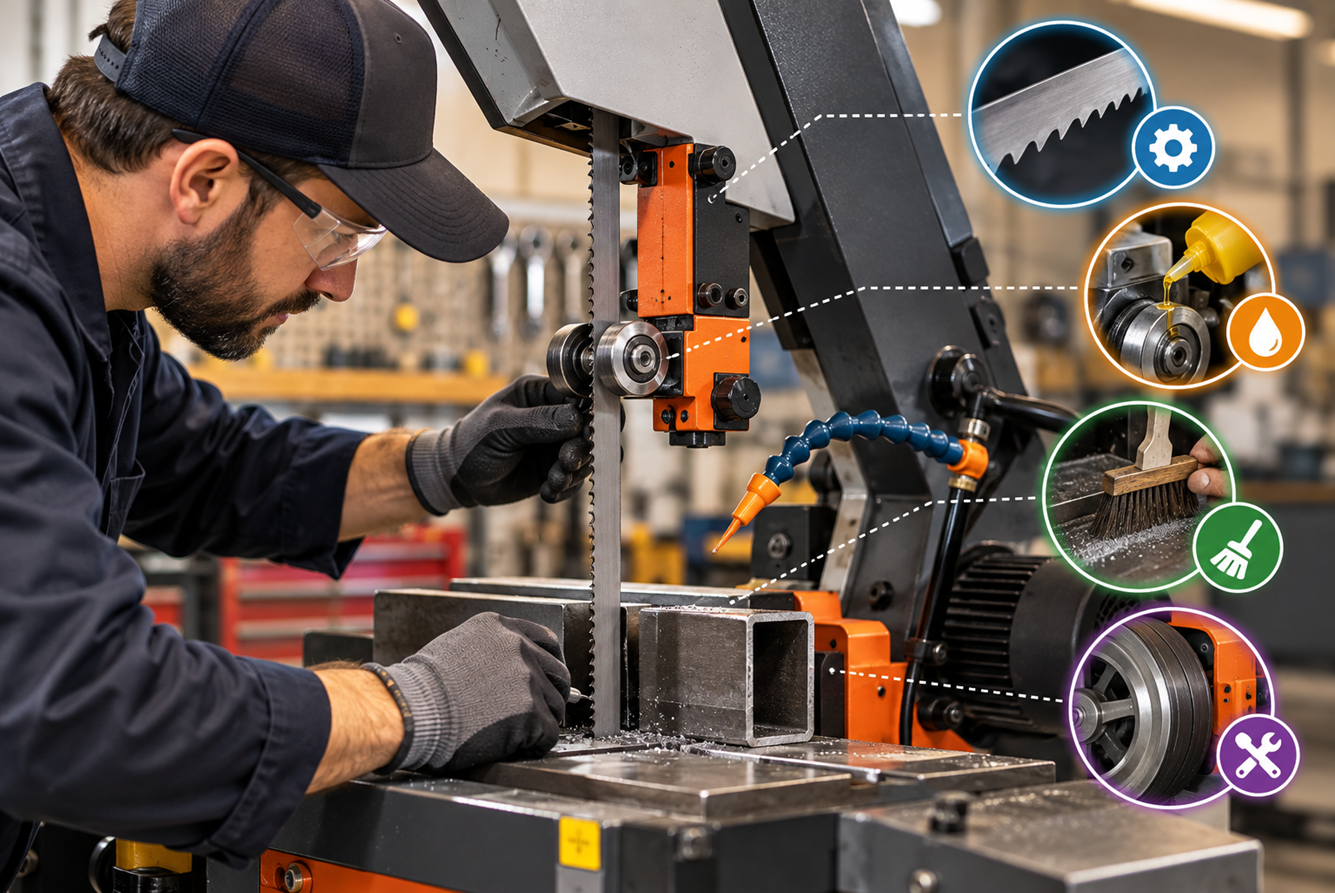
Set blade tension according to the saw manufacturer’s specifications. Too little tension can allow the blade to wander, vibrate, or produce crooked cuts. Excessive tension can place unnecessary stress on the blade and machine components.
Read the maintenance manual and choose the right tension before cutting. Don’t guess, but follow the appropriate instructions.
Keep the Blade Properly Aligned
The blade should travel correctly around the wheels and remain properly positioned within the guide system. Misaligned guides increase friction and cause uneven tooth loading.
During routine maintenance, inspect the blade guides, wheels, bearings, and tracking components. If the blade repeatedly moves away from its intended path, stop the machine, adjust, and then continue.
Use the Right Cutting Speed and Feed Pressure
Fast cutting isn’t always best. Pushing the blade through the material too aggressively shortens its life.
Excessive feed pressure generates heat, damages teeth, and increases vibration. Cutting too slowly can also create problems, depending on the material and blade design.
The correct combination of blade speed and feed pressure depends on the material, cross-section, blade type, and machine.
Keep the Workpiece Secure
The workpiece shouldn’t move during cutting, or it won’t cut as desired and will waste both material and time.
Modern machines have proper clamps that provide secure support without interfering with the blade’s path. Stable components, whether pipes, bars, sheets, or other cylindrical shapes, help produce precise results.
Clean Metal Chips Regularly
When cutting metal, metal chips are expected. Clean them properly, or they may interfere with machine movement, contribute to heat buildup, and make it harder to identify accumulating problems.
Routine cleaning is a simple maintenance task, but it can make a significant difference to long-term equipment performance.
Lubricate the Components
Lubrication reduces friction between appropriate moving components and helps prevent premature wear. However, not every component should be lubricated, and excess lubricant can attract metal chips.
Screws, guides, gear systems, or other specified components require periodic attention. A PROMAC maintenance schedule, for example, recommends regular lubrication of the vise screw and guides and periodic gearbox lubrication.
Use Coolant or Cutting Lubricant When Appropriate
Metal shearing produces heat, which should be controlled to prevent warping and material and tool damage. Use coolant or cutting lubricant to manage heat and improve blade performance.
Stainless steel produces considerable heat because of its mechanical properties and thus requires specialized cutting conditions.
The same considerations apply to a metal hole saw or a stainless steel hole saw. Cutting speed, pressure, and the right cutting fluid affect tool life and hole quality.
Inspect the Blade Before It Becomes a Problem
When do you replace the blade on the metal saw? Do you check it regularly, or do you replace it when it completely fails? The latter isn’t an option.
Inspect the teeth and blade body for signs of:
| What to check | What it may indicate |
|---|---|
| Missing or damaged teeth | Blade is no longer cutting evenly; replace before continuing |
| Cracks | Risk of sudden blade failure |
| Excessive wear | Reduced cutting efficiency and rougher finish |
| Uneven tooth wear | Possible alignment, tension, or feed pressure issue |
| Heat damage (discoloration) | Cutting speed or feed pressure is too aggressive, or coolant is insufficient |
| Abnormal vibration | Blade tension, alignment, or workpiece clamping problem |
| Damaged welds | Blade is at risk of breaking; replace immediately |
If the cuts are crooked and too rough despite proper setup, replace the blade.
Do Not Confuse Different Saw Types
A project might require different cuts and thus, different tools. You must know that every metal-cutting piece of equipment is different and serves a distinct purpose.
| Saw type | Best suited for |
|---|---|
| Metal Cutting Band Saw | Bars, pipes, tubes, plates, and other shapes within its capacity |
| Metal Cutting Circular Saw | Fast, precise cuts using a fixed rotating blade with fewer moving parts to maintain |
| Cold Saw for Metal | Transferring cutting heat into the chips rather than the blade, for cleaner cuts |
| Evolution Metal Cutting Saw | A specific multi-material cutting saw, not a general term for all metal saws |
| Hole Saw | Creating large-diameter holes — a very specific purpose |
Choosing the correct tool prevents unnecessary strain and improves both productivity and tool life.
Quality Metal Cutting Services in Albuquerque
When you need metal cutting for a project, you have two options: explore metal sawing in depth for in-house operation or choose a metal sawing expert. The former works well for small jobs, but for professional, large-volume cuts, it’s best to consult a professional with a range of machines and capabilities.
New Mexico Metals LLC is the best option for metal sawing needs in Albuquerque, whether you have retail or wholesale needs. We pride ourselves on stocking quality metals, using state-of-the-art sawing machines, and having knowledgeable staff who help you get the results you need.
Give us a call today for detailed information about our services!
Frequently Asked Questions
How often should a metal band saw blade be replaced?
There is no universal timeline, but replace it when the teeth are worn or damaged and start to cut inconsistently.
Why does my metal band saw make crooked cuts?
Crooked cuts result from incorrect blade tension, dull or inappropriate blades, misaligned guides, improper feed pressure, poor blade tracking, or an unsecured workpiece. Check these factors before continuing operation.
Can the same blade cut steel and stainless steel?
Choose a blade based on the metal. Some blades can cut both steel and stainless steel. So, check the manufacturer’s instructions before using them.
Can coolant improve the lifespan of a metal cutting saw?
Yes. A metal saw produces considerable heat during operation, which can damage both the material and the tool. Coolant prevents this and extends the life of the metal saw.
What is the difference between a band saw and a cold saw for metal?
A band saw uses a continuous toothed blade traveling around wheels, while a cold saw uses a circular blade. They differ in blade design, cutting speed, workpiece capacity, and typical applications.
Is a metal cutting circular saw easier to maintain than a metal band saw?
Yes, a circular saw is easier to maintain as it has fewer moving parts. Also, you don’t need to align and adjust the machine because the blade is fixed.