Quick answer
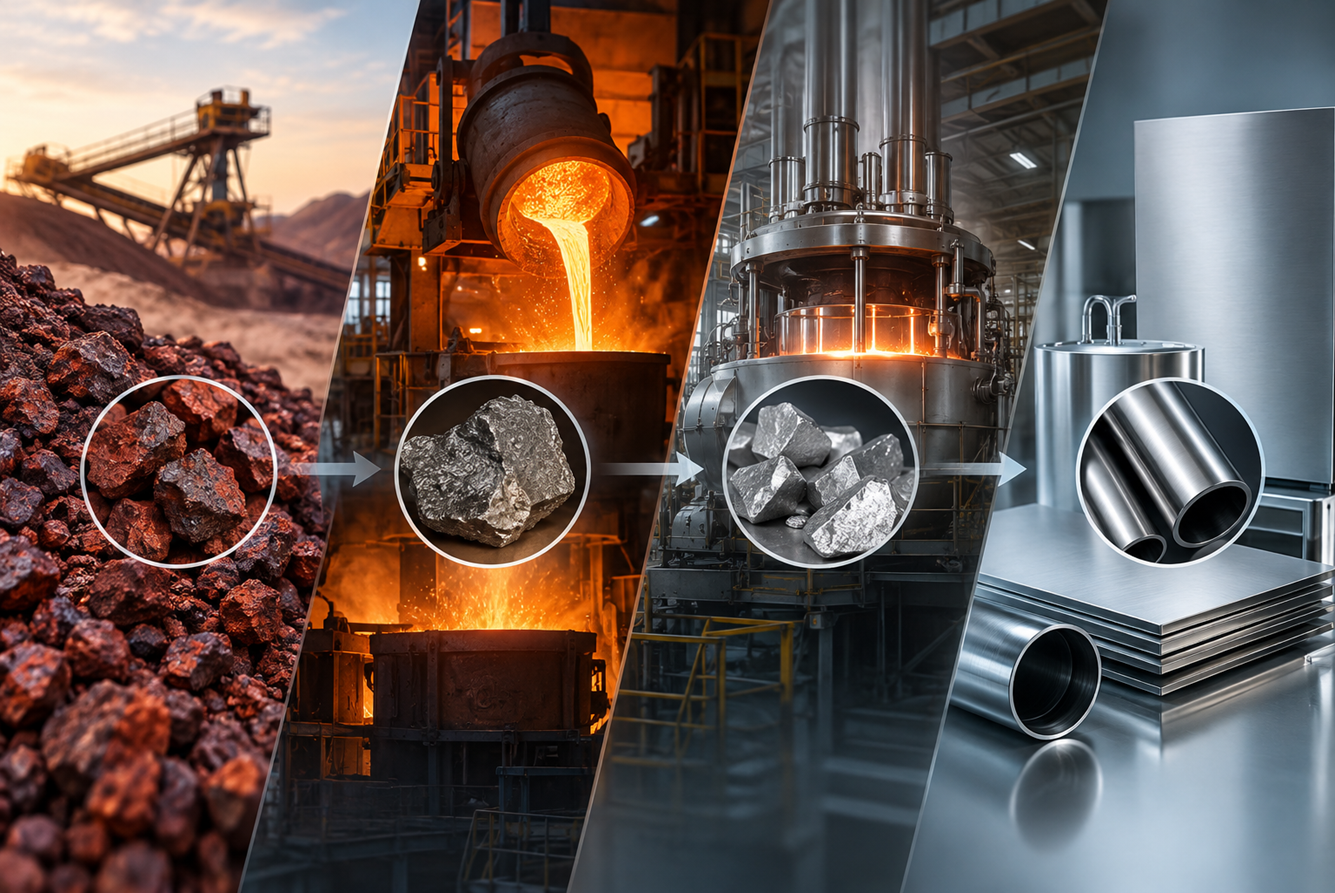
Iron ore is mined, then processed to remove oxygen and produce metallic iron, which is melted into base steel. Alloying elements — primarily chromium (at least 10.5%), along with nickel, molybdenum, and manganese — are then added to convert that steel into stainless steel. The material is refined, cast, rolled, surface-finished, and quality-tested before it reaches the market as sheet, plate, bar, pipe, tube, rod, angle, or channel.
Summary
Turning iron ore into stainless steel takes time. Iron is extracted and converted through a series of steps; hot metal is then converted to steel, and alloying elements turn it into stainless steel. The process doesn’t end there; steel is then converted into bars, plates, sections, etc. This blog discusses how iron ore is converted into stainless steel.
- Iron ore — what it is and how it is extracted.
- Stainless steel constituents and the characteristics they lend to the metal.
- How different steel grades differ from one another.
- What role stainless steel suppliers play in modern industries.
- Stainless steel products include sheet, plate, bar, pipe, tube, rod, channel, angle, and other forms.
- Choosing knowledgeable stainless steel suppliers helps businesses obtain the correct grade, dimensions, finish, and material documentation.
Stainless steel is one of the most widely used metals in the world because of its various properties. Its main constituent is iron, so understanding iron extraction is key to understanding the journey from iron ore to stainless steel.
This blog explores that journey and how it benefits various industries.
What Is Steel Iron Ore?
Iron ore is the raw material that contains iron. The mineral rocks are extracted from open pits or underground mines. Iron ore itself isn’t used to make steel, but it goes through a rigorous process of creating iron.
Iron ore comes in several forms, including:
- Hematite
- Magnetite
- Siderite
- Goethite
Step-by-Step Process: How Does Iron Ore Become Stainless Steel?
Here is the step-by-step process of converting iron ore into steel:
-
Mining and Extracting Iron Ore
Iron ore is extracted from the earth. Hematite and magnetite are the most common forms of iron ore.
The mined material is crushed, screened, concentrated, beneficiated, pelletized, etc.
-
Producing Iron from Ore
Iron ore consists largely of iron combined with oxygen. The oxygen must be removed to obtain metallic iron.
In conventional ironmaking, a reducing agent removes oxygen from the iron oxides. The resulting iron is produced as molten iron in a blast furnace or as direct reduced iron through a different reduction route.
The purpose is straightforward: transform iron oxide into usable metallic iron that can become part of the steelmaking charge.
-
Creating Base Steel
Iron alone is not yet the finished material. Steel is created by controlling iron, carbon, and other elements within a molten metal system.
Today, electric arc furnaces are widely used, especially where recycled stainless steel is a raw material. The charge is melted, and unwanted elements are controlled during subsequent refining.
-
Adding Stainless Steel Alloying Elements
This is where steel is transformed into stainless steel. Chromium provides corrosion resistance, nickel offers corrosion resistance, strength, and toughness, carbon offers hardness, and molybdenum offers high-temperature strength. Manganese contributes to strength and ductility. Nitrogen improves strength and influences corrosion resistance.
These materials are added based on the stainless steel grade being manufactured.
Alloying elements and what they contribute Element Primary contribution CrChromium Corrosion resistance (forms the protective oxide layer) NiNickel Corrosion resistance, strength, and toughness CCarbon Hardness MoMolybdenum High-temperature strength MnManganese Strength and ductility NNitrogen Additional strength and improved corrosion resistance -
Refining and Purification
The process doesn’t end with alloying; the quantities of these alloys are further adjusted.
Modern stainless steel production uses converter and ladle-treatment processes to fine-tune chemical composition before casting.
This stage is critical because excessive levels of certain elements can negatively affect corrosion resistance, mechanical performance, or processing characteristics.
-
Casting and Solidification
Once the chemical composition is within the required range, the manufacturer casts molten stainless steel into semi-finished forms such as slabs, billets, or other suitable shapes.
During solidification, the metal develops its internal microstructure. Cooling conditions and composition influence grain structure and phase formation, which ultimately affect the material’s properties.
This is why temperature control is essential rather than simply allowing molten metal to cool naturally.
-
Rolling and Forming Stainless Steel
After casting, the material is either hot- or cold-rolled:
- Hot rolling involves further heating the metal to set the thickness and develop the desired structure.
- Cold rolling involves processing steel further at room temperature.
-
Surface Finishing and Treatment
Even after hot and cold rolling, the stainless steel isn’t ready. It requires annealing, pickling, grinding, brushing, or other surface treatments.
- Annealing can restore material properties after deformation.
- Pickling helps remove surface oxides and other contaminants.
- Finishing processes also produce specific appearances or surface characteristics.
-
Quality Testing and Inspection
After steel production, quality testing and inspection take over. Not every stainless steel product manufactured is suitable for the market. Testers evaluate its mechanical characteristics, composition, dimensions, surface condition, and other specifications.
- Chemical analysis confirms that alloying elements meet the required grade.
- Dimensional inspections verify thickness, width, diameter, or other measurements.
- Additional mechanical or corrosion-related testing might be required, depending on the application.
This step ensures that stainless steel meets the quality requirements.
What Are the Most Common Stainless Steel Products?
Common stainless steel products include:
- Sheets
- Plates
- Bars
- Rods
- Pipes
- Tubes
- Angles
- Channels
Each product has distinct uses, and industries often require more than one stainless steel product for projects. So you need a reliable metal supplier that can provide the required grades and quantities on time.
How Do Stainless Steel Suppliers Deliver Materials to Industry?
Stainless steel suppliers play a crucial role in economic growth. They help industrial, commercial, construction, and maintenance customers identify and obtain material that matches their project requirements.
A capable supplier helps customers compare available grades, product forms, thicknesses, dimensions, finishes, and quantities. They also provide material information and help customers determine whether a sheet, plate, bar, pipe, tube, or another form is appropriate.
A knowledgeable stainless steel supplier can help narrow the selection based on actual requirements rather than treating every stainless product as interchangeable.
How to Choose the Right Stainless Steel Suppliers?
| Factor | What to look for |
|---|---|
| Grade Availability | Multiple stainless steel grades in stock |
| Product Selection | Sheet, plate, pipe, tube, bar, rod, angle, and channel |
| Dimensions | Ability to offer custom dimensions for your project |
| Material Knowledge | Answers questions clearly, doesn’t dodge difficult ones |
| Inventory | Broad stock for projects needing several metal types at once |
| Delivery Capabilities | Reliable, on-schedule delivery |
Consult multiple suppliers and choose one that best meets your project needs.
Benefits of Working with Stainless Steel Suppliers Near Me
People often search for “stainless steel suppliers near me” because there are multiple benefits of hiring a local supplier, which are discussed below:
- Easier communication about specifications
- Faster access to available inventory
- Convenient material pickup when offered
- Local knowledge of common industrial requirements
- Easier coordination for cutting and other available material services
- Reduced difficulty when checking dimensions or product availability
From Steel Iron Ore to High-Performance Stainless Steel
Stainless steel is in high demand, so it’s easy to be fooled by mediocre suppliers when sourcing steel for a project. You need a reliable partner that offers top-quality products, provides material quality certifications, has material knowledge, stocks multiple stainless steel grades, and has the processing capabilities for large-scale projects.
In Albuquerque, you can rely on New Mexico Metals LLC, which meets all these criteria. We have an extensive metal inventory, and we serve both retail and wholesale needs.
For more information, give us a call!
Frequently Asked Questions
How is steel iron ore converted into stainless steel?
It is a long process that starts from iron ore extraction and is followed by crushing, screening, concentrating, etc. Several alloys such as chromium, nickel, molybdenum, manganese, etc. are added to iron to make stainless steel.
What elements are added to steel to create stainless steel?
Chromium is the essential alloying element. Depending on the grade, stainless steel also contains nickel, molybdenum, manganese, nitrogen, titanium, niobium, and other elements. Each element influences properties such as corrosion resistance, strength, toughness, ductility, machinability, or high-temperature performance.
Why is chromium important in stainless steel production?
Chromium is responsible for the defining corrosion-resistant characteristic of stainless steel. At a minimum concentration of about 10.5%, chromium forms a thin passive oxide layer on the surface, which helps protect the metal from corrosion.
What is the difference between regular steel and stainless steel?
Carbon steel has iron and carbon as major constituents. Stainless steel has at least 10.5% chromium, which gives it corrosion resistance.
How do stainless steel manufacturers ensure product quality?
Stainless steel manufacturers control quality throughout the production process. They analyze raw materials, precisely control alloy composition, refine molten metal, monitor casting and rolling conditions, and inspect the finished material.