Summary
How iron is extracted from raw materials and converted into a useful metal is a long and crucial process that determines its path. The molten iron is converted into pellets and used in buildings, vehicles, machinery, and infrastructure. Learn more about this journey to learn why iron remains crucial for global economic growth.
The key highlights of the blog are:
Today, almost every industry relies on iron and steel for one process or another. Some industries use these metals as raw materials, while others use them in other forms, such as heavy machinery. Why so? Iron and steel are two very durable, strong metals that are essential to modern industries.
This blog discusses the process of extracting iron, the iron-to-steel process, and the uses of iron and steel.
Iron ore is a naturally occurring rock that must be separated from oxygen and other impurities to extract pure iron.
Commercial iron ores typically contain between 55% and 70% iron. Lower-grade ores are also extracted using beneficiation techniques.
Several kinds of iron ore are mined commercially, which are mentioned below:
Hematite (Fe₂O₃)
Magnetite (Fe₃O₄)
Goethite
Limonite
Siderite
Each ore type is different, and experts use different techniques to process them based on their impurity levels.
Higher-grade ores reduce energy consumption during iron processing, making production more efficient.
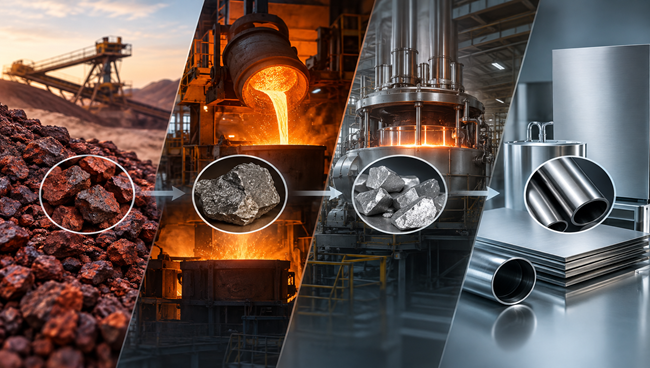
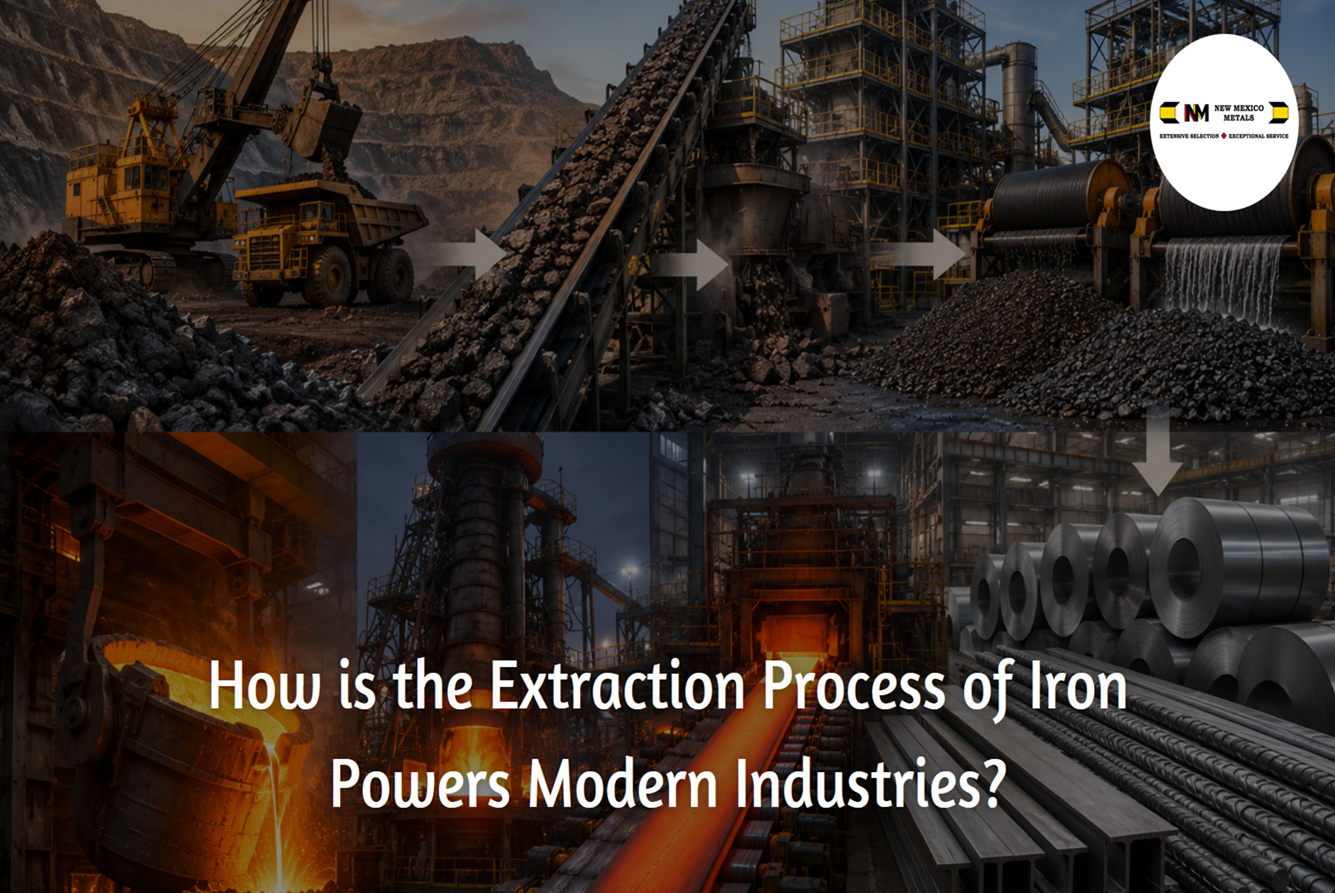
Here is the complete iron ore to stainless-steel process:
It is the first step in which iron ore is extracted through open-pit or underground mining.
Large excavators, haul trucks, and drilling equipment remove the ore before transporting it to processing facilities.
The extracted iron ore comes in different rock sizes. During crushing, larger rocks are reduced to smaller pieces. During screening, the crushed materials are separated by size. The oversized rocks are sent back to the crusher.
Beneficiation removes unwanted minerals such as silica, clay, and phosphorus.
Some common beneficiation techniques are:
These methods increase iron concentration before smelting.
The crushed iron ore isn’t directly fed into the blast furnaces. Iron ore pelletizing is the process in which producers use binders to make iron ore pellets. These are uniform in size and lead to better furnace efficiency, improved airflow, and higher productivity.
Sintering is another process that fuses fine ore particles into larger porous masses suitable for blast furnace operations.
Both processes improve furnace performance.
The iron ore doesn’t go into the blast furnaces alone, but is paired with coke, limestone, and hot air.
The coke provides heat and carbon, while limestone removes impurities by forming slag.
At temperatures approaching 2,000°C (3,600°F), iron oxides are reduced to molten iron.
Molten iron collects at the bottom of the blast furnace. This liquid iron, commonly called hot metal or pig iron, contains high levels of carbon and impurities.
It serves as the starting material for steel production.
Once molten iron leaves the blast furnace, the iron ore-to-steel process begins. The carbon content is reduced, and impurities are removed, through Basic Oxygen Furnace (BOF) or Electric Arc Furnace (EAF)
Other alloying elements are added, such as:
These elements lend specific properties to steel, such as corrosion resistance, strength, hardness, or heat resistance.
Here are some major differences between iron and steel:
Iron and steel production is energy-intensive; thus, the call for sustainability and eco-conscious practices is intense. There are several environmental challenges, such as:
Sustainability can be improved through:
The steel industry is also one of the world’s largest recyclers, with steel capable of being recycled repeatedly without losing its essential properties.
The future requires consideration today, which has led to the following innovations in the iron and steel production:
Carbon emissions are reduced by using hydrogen-based direct reduction rather than coke-based blast furnaces.
Artificial intelligence, autonomous trucks, drones, and real-time monitoring systems improve mining efficiency while enhancing worker safety.
Electric Arc Furnaces increasingly use recycled steel scrap, lowering energy consumption and reducing dependence on newly mined ore.
Every major economy depends on reliable steel production because iron extraction supports:
As urbanization continues worldwide, steel demand is expected to remain strong, ensuring that iron extraction remains a cornerstone of global industrial development.
While manufacturers are continually required to rely on the transformative process to extract iron, businesses are equally responsible for sustainability and for using metals extracted responsibly. As you read above, the process is a lengthy one that includes mining, crushing, beneficiation, iron ore pelletizing, and smelting.
While it is important to understand the different types of iron ore and the iron ore-to-steel process, it is equally important to source metals from a trusted supplier, such as New Mexico Metals LLC. We take sustainability very seriously and thus source iron that’s extracted responsibly. If you want to know more about it, give us a call today!
Que: What is the extraction process of iron?
Ans: Iron extraction includes mining, crushing, screening, beneficiation, pelletizing, sintering, smelting, and producing molten iron ore.
Que: What are the main kinds of iron ore?
Ans: The primary kinds of iron ore are hematite, magnetite, goethite, limonite, and siderite. Hematite and magnetite are the most commonly used due to their high iron content.
Que: How does the iron ore to steel process work?
Ans: After iron ore is converted into molten iron, the carbon content is adjusted, other elements are added, and steel is produced.
Que: What is the difference between iron and steel?
Ans: Iron is a naturally occurring metal, while steel is an alloy made of iron, chromium, nickel, molybdenum, manganese, etc.
Que: Why is steel and iron ore important for modern industries?
Ans: Steel iron ore is the primary raw material used to produce steel, which is essential for construction, transportation, energy, machinery, manufacturing, and infrastructure projects worldwide.

To meet the needs of both wholesale and retail customers by providing an extensive selection of metals cut to size with exceptional service.
New Mexico Metals LLC
Address: 5821 Midway Park Blvd NE # F, Albuquerque, NM 87109, United States
Phone: (505) 717-1900
FAX: (505) 717-1769
Email: info@newmexico-metals.com
8:00 AM - 5:00 PM Monday - Friday
9:00 AM - 12:00 PM Saturdays
Copyright © 2026. All Rights Reserved.
Website Design & Digital Marketing By WSI