5 Different Types of Metal Casting Process

5 Different Types of Metal Casting Process

Casting is an ancient technique that has been used for centuries to create all sorts of objects, from simple tools to elaborate sculptures.

The basic principle behind metal casting is simple: a mold is created, molten metal is poured into the mold, and the metal takes on the shape of the mold. This process is very popular because it allows for the creation of objects with very intricate designs without using complex manufacturing techniques.

In this article, we will take a look at the five most common types of casting processes.

Casting falls into two major groups – expendable mold and permanent mold – determined by the mold material.

●      Expendable

In this process, a mold is created out of a material that can be easily destroyed, such as sand. The types of expendable mold casting are; sand casting, investment casting, plaster molding, ceramic molding, shell molding, and lost-foam casting.

●      Permanent

In this process, the mold is created from a material that can withstand high temperatures, such as metals with low melting points. The types of permanent mold casting are; die casting, low-pressure casting, vacuum casting, and gravity casting.

The five common types of casting processes are:

1.    Sand casting

Sand casting is used to create objects with complex shapes. In this process, a mold is created out of sand. The metal is then melted and poured into the mold. Once the metal has cooled and solidified, the sand mold is destroyed to remove the object.

2.    Investment casting

Investment casting uses disposable wax molds to create objects with a smooth surface finish. In this metal casting process, a wax mold is created and coated with a ceramic material.

The wax mold is then placed in a kiln, where the wax is burned out, leaving a hollow ceramic mold. The metal is then melted and poured into the mold. Once the metal has cooled and solidified, the ceramic mold is broken away to reveal the object.

3.    Pressure die casting

Pressure die casting uses two plates of metallic molds to create objects with a smooth surface finish. In this process, an open mold is lubricated to prevent sticking, and the two plates are shut.

Molten metal is then forced into the closed mold with great pressure. Once the metal has cooled and solidified, the mold is opened, and the object is removed.

4.    Centrifugal casting

Centrifugal casting uses the force of centrifugal acceleration to create objects with a very smooth surface finish. In this process, the mold is rotated at high speed while the molten metal is poured into it.

The centrifugal force acting on the metal causes it to be evenly distributed throughout the mold. Once the metal has cooled and solidified, the mold is opened, and the object is removed.  The centrifugal force causes a lot of impurities to move to the ID and OD which can be machined off and create a more pure grade of material.

5.    Gravity casting

Gravity casting uses the force of gravity to create objects with a very smooth surface finish. In this process, the mold is placed in a horizontal position, and the molten metal is poured into it.

The force of gravity causes the metal to be evenly distributed throughout the mold. Once the metal has cooled and solidified, the mold is opened, and the object is removed.

Another gravity casting process is used when making many steel shapes where the liquid metal passed through the mold through an opening in the bottom which allows the material to flow into the caster for further reduction to a final shape and rolling.

Final Thoughts

There are many different casting processes, each with its advantages and disadvantages. However, the type of casting process that is used depends on the desired final product.

If you have any questions about the casting process or need help finding the right casting process for your project, don’t hesitate to get in touch with New Mexico Metals LLC. We are experts in metal casting, and we would be happy to assist you!

Contact us today to learn more about our services!
5 Metal Drilling Tips for Making Holes in Hard Metal

5 Metal Drilling Tips for Making Holes in Hard Metal

If you are a DIY enthusiast who loves working with metals, you probably have encountered the difficulty of making holes in hard metal. It is not an easy feat, but with the right tools and techniques, you can make perfect holes in any type of hard metal, whether it’s aluminum, steel, or something else entirely.

This article will give you 5 metal drilling tips to help you make holes in hard metals like a pro!

1.    Pick the right drill press

A drill press is a must-have if you often work with metals and other materials. This press allows for precise drilling and provides stability when drilling. Drill presses are made to handle different kinds of metal.

Less powerful drill presses are sufficient when working on softer metals. However, hard metals like cast iron and hardened steel require powerful drill presses that can manage the extra torque.

2.    Choose the right bit

Most drill bits are made using high-speed steel and can drill effectively through most metals, including other materials like plastic and wood. However, if you need to drill holes through hard metals, you will require a different bit.

Drill bits made from cobalt blend or black oxide are most suited for hardened metals. Bits made from black oxide are of superior quality and last 50% longer than high-speed steel (HSS).

Although a bit pricey, these drill bits have an extra 5 – 8% cobalt, making them more resilient, sharper, and heat resistant.

3.    Lubricate your bits

Some people don’t find it necessary to use a lubricant when drilling softer metals. Drilling hard metals require cutting oil or a multi-purpose oil for lubrication. Lubrication makes the metal drilling process easier and helps your bits remain sharp by reducing friction and keeping the bits cool.

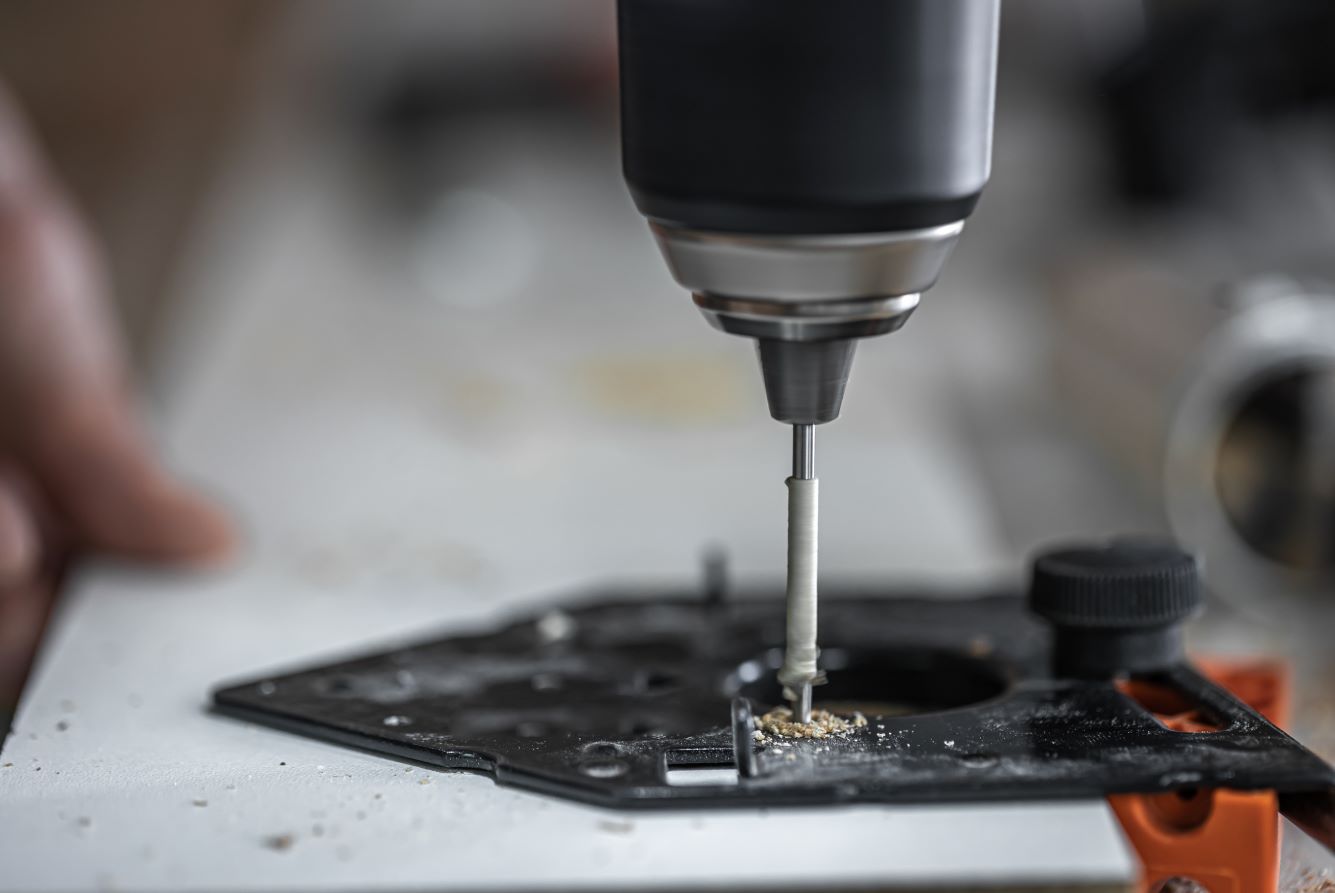
4.    Start by drilling the pilot hole

A pilot hole is a small hole you drill before making the actual hole. The pilot hole helps to ensure that your bit doesn’t wander when you start drilling the larger hole. It also helps to prevent the bit from slipping and breaking.

When making a pilot hole, use a smaller bit than the one you plan on using for the final hole, and drill slowly. This will make it easier to drill the larger hole and get a clean, accurate result.

5.    Apply slow drilling speed and the right pressure

Setting the right speed and applying the appropriate downward pressure when drilling is vital. The rule of thumb in drilling is to slow it down as much as possible.

Going with lower speeds of up to 3000 RPM for smaller bits and 1500 RPM for larger bits will ensure you don’t damage your bits and that your drilling is accurate.

Also, as you drill slowly, apply a downward pressure that is firm and steady enough to produce long shavings. If you are getting tiny shavings or dust particles, it’s a sign that you are not applying enough pressure or that the drill tip is dull and in need of re-sharpening.

Key Takeaway

Drilling holes in hard metals is not as difficult as it may seem. By using the right tools, lubrication, and technique, you can achieve perfect holes without any trouble. Remember to take your time when drilling and to apply firm and steady pressure for the best results.

If you need help with any project that requires drilling through hard metals or have any questions, feel free to contact New Mexico Metals LLC.  We are the leading experts in this field and would be happy to offer our assistance. Contact us today for all your metal drilling needs!

The Basic Guide and Tips for Metal and Steel Bending

The Basic Guide and Tips for Metal and Steel Bending


One common process in metal fabrication is bending. Bending metals allows you to create various shapes and sizes for your project. But how do you go about bending metals?

This article will focus on the metal bending. We will explore the basic steps and tips for bending metals. But first, let us look at what bending is and why bending is important.


What is bending?

Bending refers to the process of deforming ductile materials like metal into an angular shape. This can be done by applying force to the material, either manually or with the help of a machine.

There are two types of bending processes: cold and hot.

Cold bending is a process that uses a machine to bend the metal. This type of bending does not require heat, which makes it ideal for thinner metals. The process works by using a punch and die that shape the metal as it passes through the machine.

Hot bending is a process that uses heat to soften the metal before it is bent. This process works by heating the metal until it becomes malleable and then using a die to shape it.


Importance of bending metals

  • Bending metals makes it possible to create various metal shapes and sizes for your project.
  • Also, it allows you to add details on the metal that otherwise would not be possible with other methods.
  • In addition, bending metals is cost-effective, as it does not require additional materials or processes.
  • The process is also faster and can be completed in a short amount of time.

Tips to help you make clean bends on your metal

Pick the best material for bending

The malleability of materials is different; therefore, you must pick the right material. Here are some materials that we recommend for metal bending:


●      Steel

Steel bending is ideal for projects that require great strength and durability. We recommend using low-carbon steel if you are looking for a metal that is easy to bend and has a low risk of cracking.

Also, if you are looking for a material that is resistant to corrosion and can be bent into complex shapes, we recommend using stainless steel.


●      Aluminum

The three commonly used aluminum alloys for bending are 3003-H14, 5052-H32 and 6061-T0.

6061-T0 is a dead soft all-purpose aluminum alloy that can be welded, riveted, or glued. It is also heat-treatable, making it ideal for bending.

5052-H32 and 3003-H14 are aluminum alloys that are also weldable but not heat-treatable. They are more corrosion-resistant than 6061-T) and the 5052-H32 is often used for marine applications.


Use a jig or fixture for consistent bends

When bending metals, it is important to ensure that the bends are consistent. The best way to do this is to use a punch and die.

A punch is a tool that is pushed into the material to be bent.  The die is a tool that allows the material to form into a crevice when the punch is pushing into the material

Both punches and dies help to ensure that the bends are of the correct angle and size.


Final Thoughts

Having the requisite skills to bend metal is not enough; you also need the right tools and equipment. In addition, you need to understand the different types of metals and alloys and how they behave when bent. With these tips, you should be able to make clean bends on your next project.

If you are looking to have your metal parts bent for your project, New Mexico Metals LLC is here to help. We have the experience and expertise to help you with all your metal bending needs.

Contact us today for a free quote!

How to Choose the Grade of Metals according to your Need?


Steel is used in various applications. From kitchen utensils to structural components, it is used everywhere. But do you think that the same grade of steel is used for all different applications? No. Different grades of metal are chosen carefully for any given task or application.

Factors To Choose Grade of Metals

Consider these important factors before you zero in on a grade of metals according to your need.

Steel Quality

The quality of a grade can be judged based on these factors:

Strength: Whether you are looking for a strong grade of metals or looking for a softer one. Is the metal grade strong enough to handle the pressure?

Hardenability: It is the measure of how much the metal can be hardened after the heat treatment.

Ductility: It is the ability of the metal to be transformed into shapes without breaking. Whether you are looking for a ductile grade of metal or a hard one?

Toughness: It is the measure to which a metal can take stress before breaking.

These mechanical qualities come from how the steel is treated and what alloys are mixed with steel. Chromium, when added to steel, creates stainless steel, which makes it corrosion-resistant. When nickel is added, it increases the ductility of the metal. Carbon steel contains 0.1-2% of the carbon by weight, which affects hardness.

Apart from this, steel quality is also impacted by the heat treatment it receives, the temperature at which it is cooled, and the process used for hardening.  The level of heat treatment is dependent on the alloying elements in the chemistry of the material

The Environment of Usage

What do you need the metal for, or what will be the environment for the metal? You must know the answer to this question. Whether it will be used in high temperatures or extremely low temperatures, whether it will be exposed to road chemicals or snow, whether corrosion resistance is a major factor for you, etc.

If you are looking for corrosion resistance, austenitic stainless steel or aluminum can be your choice.  Most stainless steel grades are corrosion-resistant.  If easier machining is desired, T303 is a good choice.  If exceptional corrosion resistance is needed (as with acidic environments) T316 is a common choice.  T304 has very good corrosion resistance also and is a common go-to grade for general purpose use.  If the metal will be used in high temperatures, then a range of more exotic stainless or alloy steel may be the best material.

Formability

Formability is the ability of a metal to deform without breaking. Ask yourself the question of whether the application requires good formability or not. If you are using the metal for industrial or structural purposes, then strength and toughness are of utmost importance, and for other usages, such as manufacturing kitchen utensils, screws, etc., ductility is paramount.  For items to be bent of formed into a specific shape such as a countertop or angled bracket, material formability is essential.

Material Cost

Higher the quality, the higher the cost. When you choose a grade, learn about its maintenance, replacement, and other future costs. If you are looking for a corrosion-resistant grade of metals, such as austenitic steel grades, then it is the most expensive one but worth the cost. Carbon steel is the least expensive one and is best suited for industrial and general-purpose usage.

Based on your usage, learn about the cost of grades of metals, both present, and future, and choose a grade that best suits your purpose.

Weldability

The selection of steel grade also depends on whether it will be welded or not. If yes, then low-carbon steel is the best grade. Many austenitic stainless-steel grades are easy to weld. High carbon and alloy steels are hard and strong, and, thus, not very easy to weld. Carbon steel grades 1008, 1010, and A36 as well as T304 and T316 stainless are some of the easier weldable steel grades.

Machinability

Will further applications require metal cutting? If yes, then you need a machinable grade of metals. Machinability refers to the ability of a metal to get cut smoothly. Generally, steel is a machinable metal, but there are metal grades that pose difficulty. Consult your metal supplier if you are confused.

Types Of Steel Grades

Steel is divided into four major categories.

Carbon Steel

It is named carbon steel because it contains carbon. The presence of carbon makes it look dull and matte. It is a strong steel type.

Tool Steel

It is named such because of its usage. It is a hard steel type with tungsten, cobalt, and molybdenum, making it hard and strong, thus being used in making tools such as cutters, hammers, blades, etc.

Stainless Steel

It is the most commonly used steel type when corrosion resistance is preferred and is used for various applications. It can be polished to a high gloss like a mirror or any other surface conditions and gets its strength and non-magnetic property from Chromium which forms 10%-30% of it. It is used in making kitchen appliances, utensils, medical equipment, surgical equipment, etc.

Alloy Steel

It is called alloy steel because it is a mixture of various metals like chromium, molybdenum, copper, aluminum, and nickel. The composition of the metals defines their strength and, thus, their use.

Shop From the Best

No matter the purpose or end use, New Mexico Metals LLC houses every type of grade of metal for you to choose from. We have 19000-line items, and we can source your exact requirement as well.

Visit us anytime to choose the required grade of metals according to your need.